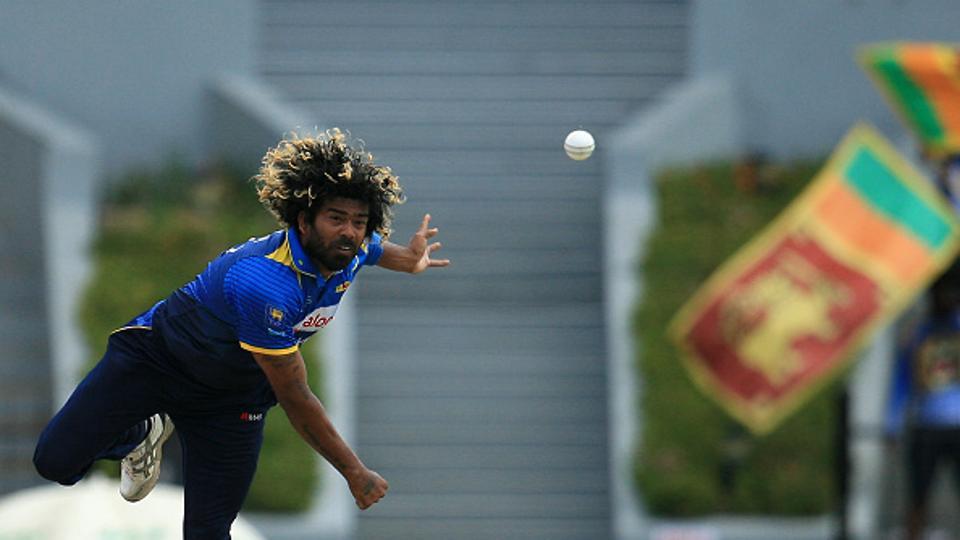
Lasith Malinga has been associated with the imagery of bleached yellow curly hair, pierced eyebrows, tattoos, and deadly yorkers. No-one can forget the kiss before before ball, the freaky sling as he bowls or even the smile after being hit for a boundary. The 145 km/hr toe-crushing yorkers he bowled to the likes of Pollock and Dhoni will be cherished by cricket fans for a long time.
Malinga was one of those kids who grew up playing cricket in the beaches of Rathgama, a coastal village situated 12 km northwest of Galle.
Malinga was lucky enough to meet one of the already famous hyper-local kid, who was a former Sri Lankan pacer, Champaka Ramanayake. Ramanayake like any other cricketer was popular with the tennis ball on the beaches. He recognised Malinga’s talent and amused by the unconventional bowling action, where the ball is almost released parallel to the surface.
This unique bowling style would require more practise and Ramanayake would glue a pair of boots to the crease and Malinga would spend hours hitting them, hence perfecting his famed yorker. (This daily activity during his training days probably made him bowl those deadly toe crushing yorkers in International cricket!)
His raw talent wouldn’t be hidden for long, creating ripples in the domestic circuit leading to him getting fast-tracked into national reckoning. He made his Test debut in Australia in 2004, where his skiddy pace saw him among the wickets and his well-directed bouncers troubled the batsmen. He ended up taking six crucial wickets in that match.
He did a remarkable job in 2006/07 tour of New Zealand where dismantled the New Zealand top order and helped Sri Lanka to draw the match. But Malinga’s true calling wasn’t Test cricket. It was the shorter format of the game. He decided to retire from Test cricket on April 22, 2011 on the grounds of injury. He also wanted to pay more attention to the ODIs and T20Is.
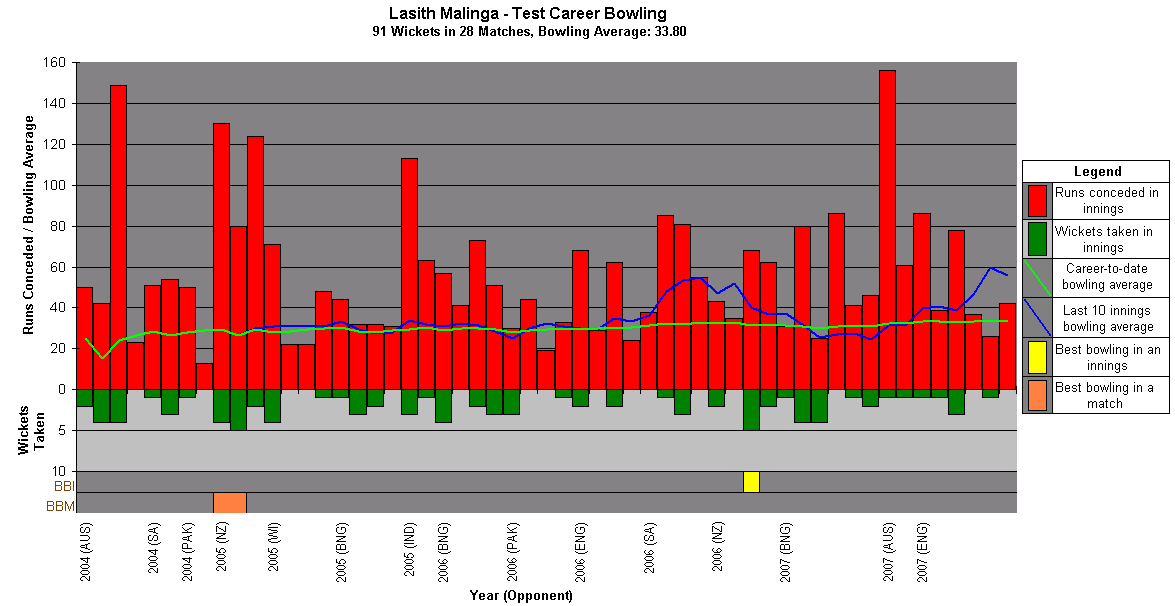
Lasith Malinga’s test bowling career from 2004- 2007
Let’s look at some of his records first:
- Only bowler in cricketing history to take four wickets in four consecutive balls in international cricket (v. South Africa March 2007).
- The first and, to date, only bowler in cricketing history to take three hat-tricks in One-Day International cricket, taking his third in August 2011.
- Lasith Malinga and Angelo Mathews hold the highest run partnership for the 9th wicket in an ODI: 132 runs, against Australia in Melbourne in 2010. Malinga scored 56 Runs from 48 balls including six fours and two sixes; Mathews scored 77 runs off 84 deliveries including eight fours and one six.
- His 56 is the fourth highest ODI score by a number 10 batsman in ODI history and he has the record for the highest ODI score for Sri Lanka when batting at number 10 position (56). He is also the only Sri Lankan to score a fifty in no 10 position in an ODI.
- He is the only bowler with two World Cup hat-tricks, against South Africa in the 2007 Cricket World Cup and the other against Kenya in the 2011 Cricket World Cup.
- Best Twenty20 figures in Australian domestic and 2nd in the world.
- As of April 2017, Malinga is the second highest wicket-taker in all Twenty20 matches with 317 wickets in 232 games.
- Malinga holds the highest number of wickets (170) in the Indian Premier League.
- As of 19 January 2017, Malinga holds the best figures in BBL history with 6/7.
- Fourth Sri Lankan to achieve 300 ODI wickets, after Muralitharan, Vaas and Jayasuriya. He is the fifth quickest bowler to reach the landmark (203 matches).
- Quickest to achieve 50 ODI wickets in World Cups (26 innings).
- Third highest wicket taker in World Cup history (56 wickets).
The 2014 T20I World Cup saw a different avatar of Malinga. After the Sri Lankan management decided to drop Dinesh Chandimal, they made Lasith Malinga as the captain of the team. The Sri Lankan team found a leader in him. Bowling yorkers at the death to stifle the Indian batting order, he ensured that the trophy finally came home – leading Sri Lanka to one of its finest moments on the cricketing field. It made him only the second captain of his country after Arjuna Ranatunga to lift an ICC World Cup. But his captaincy was also short-lived as he was constantly in and out of the team due to his injuries.
Malinga has a history of injuries and numerous surgeries, which meant numerous comebacks. Despite losing pace and fizz in his bowling towards the latter stages of his career, he’s still one of the deadly bowlers in the limited over cricket. Malinga decided to retire from the ODIs after 2019 cricket World Cup.
 What The Duck!